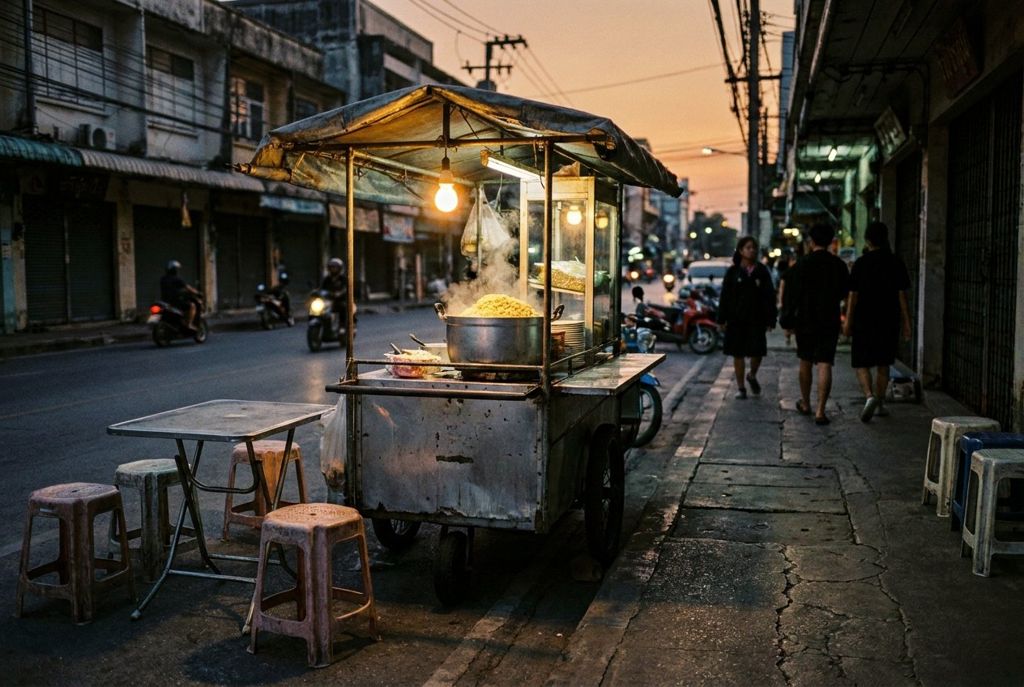
Carts arrive and leave with the hours, shophouses open their fronts to the street, and ordering often comes down to pointing. A few habits make it all easier.
- From the BTS
- Any station, then any soi
- Best time of day
- After dark
- Getting there
- Walk any soi off Sukhumvit Road
- Bring
- Small notes, tissues, an appetite
Plastic stools line the kerb after dark, steam rises from the noodle pots, and motorbikes squeeze past the tables. Carry small notes; change for large ones runs short.
Eating on a Bangkok soi does not follow a fixed menu or schedule. Food is cooked on carts that roll up and roll away, in shophouses with their fronts open to the street, and at small stalls set up on corners. The offering changes through the day, and part of the pleasure is noticing what appears when. On a long road like Thong Lo, you can eat well without ever planning ahead.
Carts that keep their own hours
Early in the morning, carts sell rice porridge, grilled pork skewers with sticky rice, and fried dough sticks with sweet soy milk. These serve people on their way to work and school and are often gone by mid-morning. Around lunchtime, rice and curry stalls appear, with trays of ready-cooked dishes to spoon over rice. In the afternoon, fruit carts and drink stalls do steady trade. After dark, the noodle carts, grills and stir-fry stalls take over, and plastic stools fill the pavement.
The same corner can host three or four different vendors in a single day. A stall you liked at breakfast may be nowhere to be seen at dinner, and another will be in its place. Come back at the same time another day and your stall will likely be there again.
Ordering without much Thai
Pointing works. Many stalls specialise in one or two dishes, so the food you see is the food on offer. Point at what you want, hold up fingers for how many, and you will be understood. Learning a few words helps: a polite thank you, and the words for spicy and not spicy, go a long way.
At rice and curry stalls, point at the trays to choose one, two or three dishes, which are spooned over a plate of rice. At grills, choose skewers from the tray and they will be reheated over the coals. At shophouses with menus, there may be pictures or an English list; if not, pointing at a dish on a neighbouring table is perfectly acceptable.
Noodle soup, step by step
Noodle stalls usually ask a few questions. First, the type of noodle: thin rice noodles, wide flat rice noodles, very fine rice vermicelli, or yellow egg noodles. Next, soup or dry; dry noodles come with a little broth on the side. Then the meat or fish balls, depending on what the stall makes. If you do not understand, point at a bowl someone else is eating and smile.
Also on the blog: Thong Lo through the year: heat, rain and the cool months
The condiment caddy
On most tables, you will find a small rack of condiments. These are there for you to adjust your dish, especially noodle soup, to your taste. A typical caddy holds:
- Fish sauce, often with sliced chillies in it, for saltiness.
- Vinegar with chillies, for sourness.
- Dried chilli flakes, for heat.
- Sugar, which many people add to noodle soup.
Taste first, then add a little at a time. A spoonful of dried chilli can turn a mild bowl into something very hot. Thai diners often balance sweet, sour, salty and spicy themselves, so do not be surprised to see neighbours adding sugar to soup.
Eat with a fork and spoon for rice dishes, pushing food onto the spoon with the fork. Chopsticks are usually offered for noodles. Tissues are often on the table in a small box; carry your own in case.
Fruit and iced drinks
Fruit carts sell cut pieces in glass cases kept cool with ice: pineapple, watermelon, papaya, guava and green mango, depending on the season. Choose a piece and the vendor bags it with a wooden skewer. Many come with a small packet of salt, sugar and chilli for dipping, which is especially good with sour fruit.
Drink stalls make iced tea, iced coffee and fruit drinks to order, often very sweet. You can ask for less sugar, although the result may still be sweeter than you expect. Drinks are often served in a plastic bag or cup with a straw, filled with ice.
Using your own judgement
Most people eat street food in Bangkok every day without trouble. Some simple habits help:
- Choose stalls with a steady crowd; turnover keeps food fresh.
- Prefer food cooked hot in front of you.
- Drink bottled or sealed water; ice in commercial cubes with a hole through the middle is generally made from treated water.
- If something looks like it has been sitting in the heat for hours, skip it.
Pay when you finish, unless the vendor asks first. Cash is normal, and small notes make life easier for everyone. Clear your space if there is nobody to do it, and give your stool back to the stack when you leave. In the rainy months, carts shelter under awnings or pack up early; the seasons on the soi shape what you will find and when.